
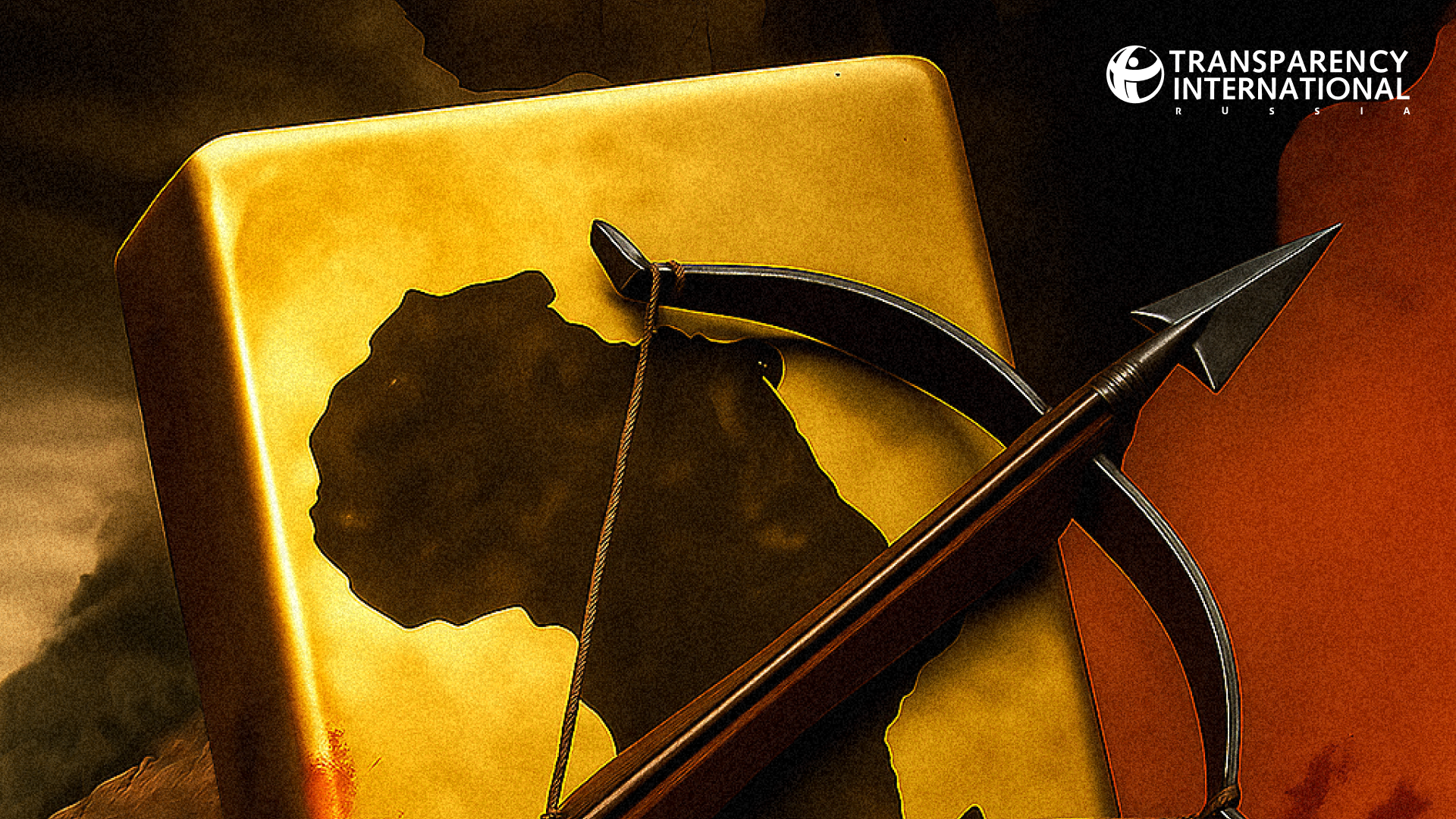
Transparency International Russia (in exile) has published a new investigation revealing Wagner’s Africa gold trade operations, enabling illegal trafficking and sanctions evasion. The full report is available for download below.
Wagner’s Africa Gold Trade: Key Findings
Since the start of Russia’s full-scale war in Ukraine, African gold smuggled through Kremlin-linked networks has generated over $2.5 billion in revenue, despite Western sanctions and asset freezes.
The investigation, “Gold and Crossbows: How Russian Mercenaries Enable Dirty Business in Africa,” shows how private military contractors — including the infamous Wagner Group and its successors — have entrenched themselves in the Central African Republic (CAR), Sudan, and Mali. In exchange for bolstering authoritarian regimes, they gain privileged access to gold, diamonds, timber, and other extractive assets. Russian-linked actors export these resources through the United Arab Emirates (UAE), one of the global centres for unregulated African gold trade.
- Central African Republic: Wagner forces have propped up President Faustin-Archange Touadéra’s government and seized control of significant gold and diamond mines, often violently displacing artisanal miners. Over 900 civilians have been killed since 2020 in operations linked to Russian mercenaries.
- Sudan: Wagner-linked companies such as Meroe Gold have exploited political instability to extract and smuggle over $1.9 billion gold. Even after President Omar al-Bashir’s fall, Russian actors entrenched their presence by collaborating with both government forces and rival militias.
- Mali: The junta welcomed Russian mercenaries in 2021 but has failed to secure significant mining concessions. Still, the military government reportedly paid them up to $200 million for combat services.
- All three countries: Smuggled gold is routed through the UAE, the world’s top importer of undeclared artisanal African gold. The UAE’s lax regulation has made it a critical blind spot in global anti-money laundering efforts.
“This is not just about mercenaries – it is about the intertwining relationship of Russian business, military units, and the local governments in Africa,” said Gleb Golubkov, researcher at Transparency International Russia (in exile) and the report’s author.
“What we are seeing in Africa is a sophisticated model where violence and extractive trade go hand in hand, serving both geopolitical and financial goals of Russia.”
A Durable Model for State Capturing
The study reveals that Russian African operations are profit-making ventures and instruments of long-term political influence. Transparency International Russia (in exile) warns that the Kremlin has built this hybrid model, combining military intervention and resource capture to promote its interests in Africa.
“We are witnessing a system, not a series of isolated cases. And this system is built to endure regime changes and civil wars,” added Golubkov.
Contact for Media
For further information, interviews, or media enquiries, please get in touch with TI-Russia PR Manager Ivan Korzh at [email protected].
Download the Full Report
Gold and Crossbows: How Russian Mercenaries Enable Dirty Business in Africa