Transparency International has released the 2025 Corruption Perceptions Index (CPI). This year, Russia scored 22 out of 100 and ranks 157th out of 182 countries. It shares this position with Honduras, Zimbabwe, and Chad. While the score remains unchanged from 2024, Russia has fallen three more places in the global ranking—a new record low.
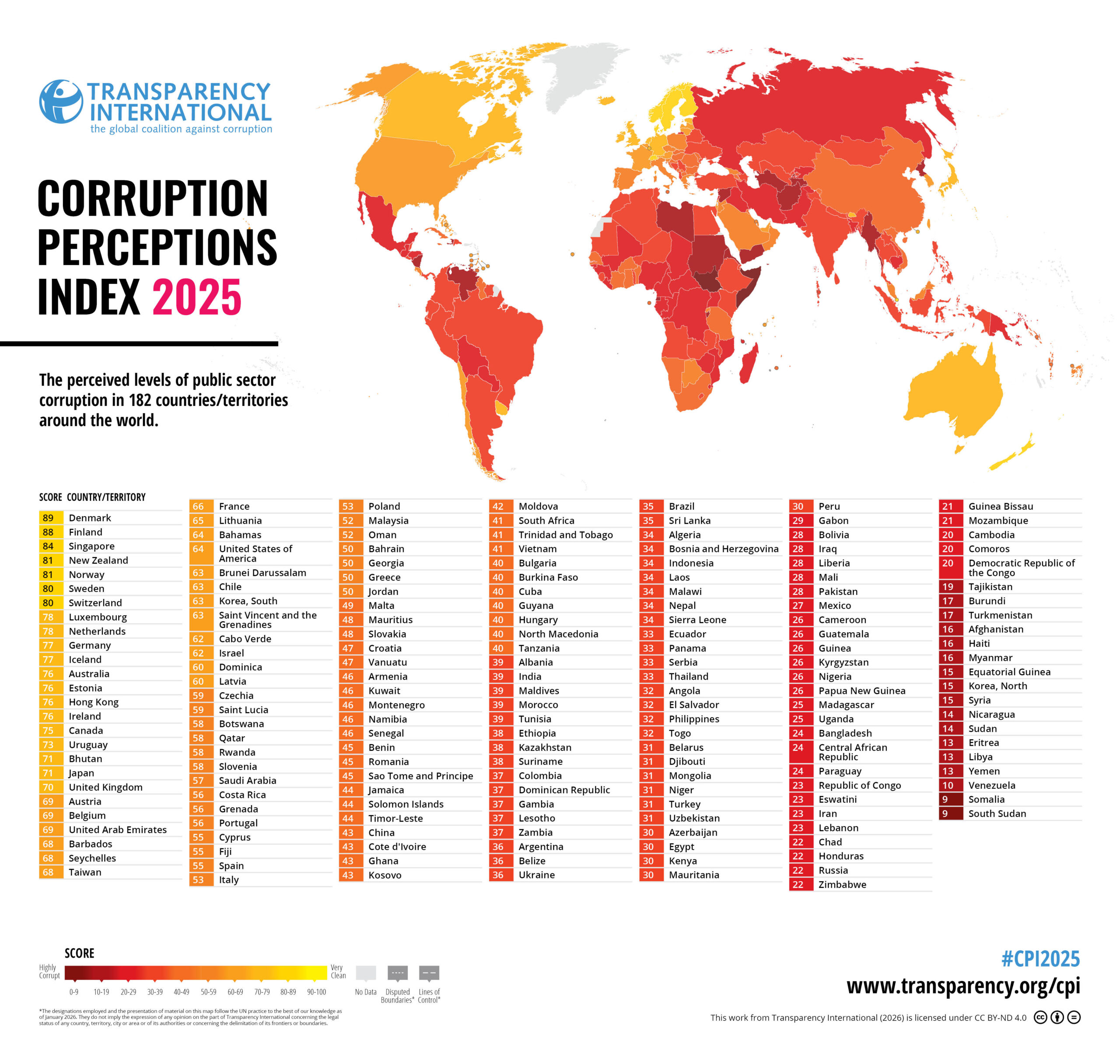
The Corruption Perceptions Index is the leading global ranking of public sector corruption. It evaluates 182 countries and territories based on expert assessments from 13 independent sources, including the World Bank, Freedom House, and risk consultancies. A score of 100 means a country is perceived as very clean; a score of 0 means it is perceived as highly corrupt.
In 2024, Russia also scored 22 but ranked 154th. That year, Azerbaijan had the same score. In 2025, Azerbaijan improved by 8 points and jumped 24 places. Even compared to countries with historically high corruption levels, Russia’s position continues to deteriorate.
Institutional Breakdown and Political Repression
Russia’s decline reflects deep institutional degradation. Since launching its full-scale war against Ukraine in 2022, the Russian government has intensified its crackdown on civil society, free media, and transparency. Government spending and procurement have become increasingly opaque, creating fertile ground for widespread corruption.
“The 2025 CPI shows that corruption remains entrenched in Russia due to government secrecy, pressure on independent institutions, and the absence of accountability. The public sector continues to serve the interests of a narrow elite rather than those of citizens. A corrupt state means vulnerable hospital patients, rising medicine prices due to collusion, fear of police abuse, and a lack of justice in courts. Each year, we tally up the results, and once again, they are bleak. We believe a different path is possible—but that would require ending the war and repressions, restoring access to vital public information, and supporting independent media. Those in power must take these steps, but we will continue pressing for change through investigations and analysis,” says Alyona Vandysheva, Executive Director of Transparency International Russia.
Leadership Vacuum in the Global Anti-Corruption Effort
Across much of Europe, the fight against corruption has stagnated over the past decade. Since 2012, 13 Western European and EU countries have dropped in score, while only seven have made meaningful progress.
The United States (64 points) recorded its lowest CPI score in history. Although the events of 2025 are not fully captured in the data, moves undermining judicial independence and suppressing dissent have raised red flags. The suspension of enforcement of the Foreign Corrupt Practices Act and cuts in U.S. funding for civil society have weakened global anti-corruption efforts. Some authoritarian leaders took this as a signal to further tighten the screws on NGOs, journalists, and watchdog groups.
A high CPI score doesn’t mean a country is free from corruption. Some top-scoring countries still enable global corruption by laundering illicit wealth or shielding it in secretive financial systems. Switzerland (80) and Singapore (84), while CPI leaders have drawn criticism for facilitating cross-border corruption.
Global Trends: Weak Oversight and Widespread Stagnation
The global average CPI score remains at 42—the lowest since 2012. Over two-thirds of countries scored below 50, indicating widespread failure to control public-sector corruption. In total, 122 out of 180 countries fall below the midpoint.
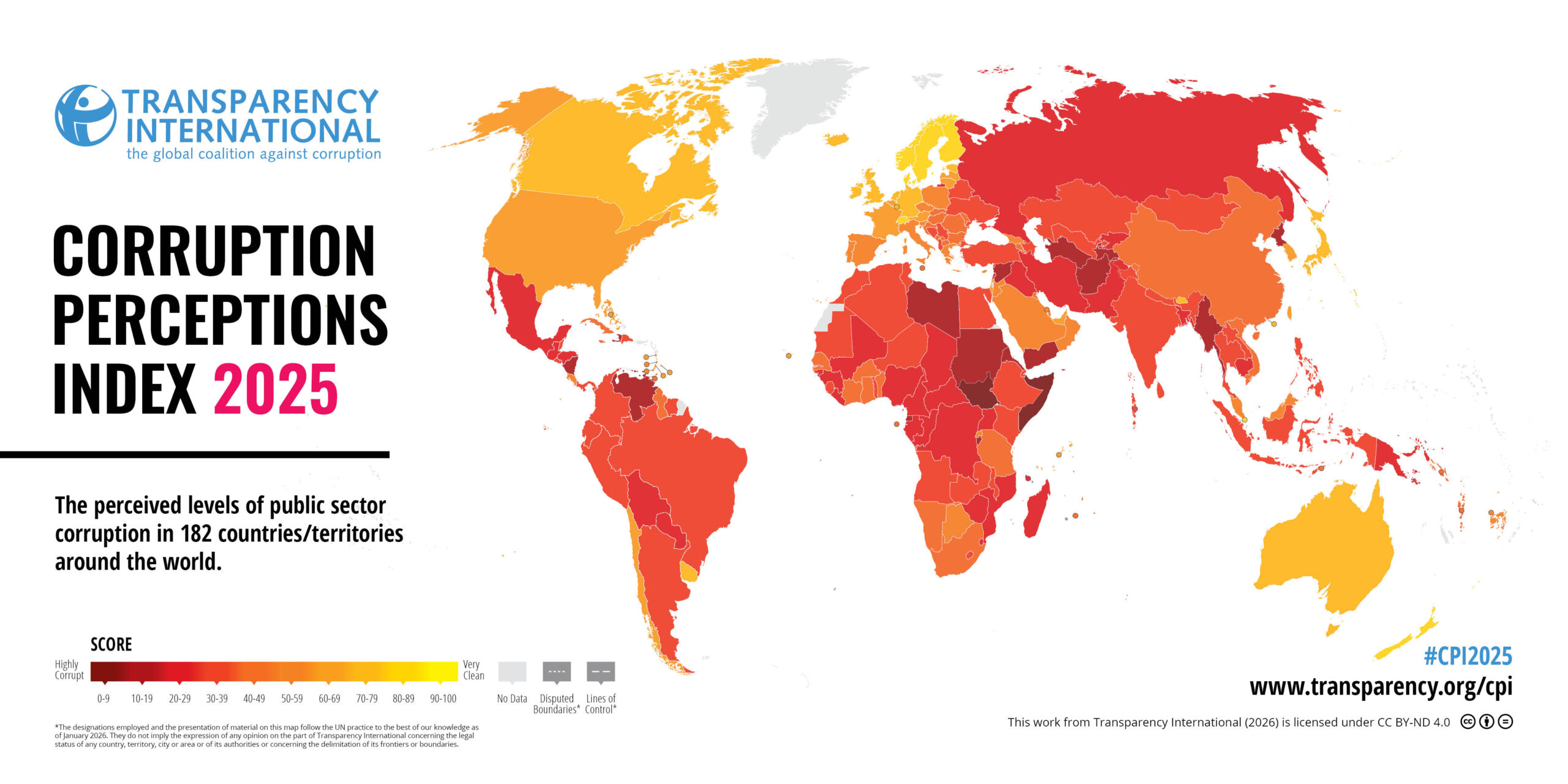
Top scorers in CPI 2025:
- Denmark (89) remains in first place for the sixth consecutive year.
- Finland (88) and Singapore (84) complete the top three.
Lowest scorers:
- South Sudan (9), Somalia (9), Venezuela (10), Yemen (13), and Libya (13).
“Corruption is not inevitable. Our research and experience as a global movement fighting corruption show there is a clear blueprint for how to hold power to account for the common good, from democratic processes and independent oversight to a free and open civil society. At a time when we’re seeing a dangerous disregard for international norms from some states, we’recalling on governments and leaders to act with integrity and live up to their responsibilities to provide a better future for people around the world,” said François Valérian, Chair of Transparency International.
In Eastern Europe and Central Asia, the regional average holds at 34, making it one of the least transparent regions in the world.

Notable Changes in Eastern Europe and Central Asia (statistically significant changes: ±4 points)
Countries with meaningful improvement:
- Ukraine (36, +1)
- Bosnia and Herzegovina (34, +1)
- Azerbaijan (30, +8)
- Kyrgyzstan (26, +1)
Countries with significant decline:
- Georgia (50, -3)
- Armenia (46, -1)
- Moldova (42, -1)
- Kazakhstan (38, -2)
- Serbia (33, -2)
- Turkey (31, -3)
- Belarus (31, -2)
- Uzbekistan (31, -1)
No change:
- Tajikistan (19)
- Turkmenistan (17)
Recommendations
Despite multiple high-profile scandals and investigations involving top officials, Russia shows no signs of progress in anti-corruption policy. Secrecy around public procurement, assets, and officials’ income—established in 2018—has now become entrenched.
With domestic oversight systems paralyzed, Transparency International Russia directs its key recommendations to international actors and regulators:
- Establish tighter controls over crypto exchanges and platforms linked to Russian financial flows. Automatic data exchange between platforms must be implemented to detect and block money laundering schemes.
- In light of restricted access to Russia’s corporate and property registries (EGRUL and EGRN), EU countries must ensure complete transparency in their own beneficial ownership registers to prevent concealment of Russian politically exposed persons’ assets.
- Expand the use of universal jurisdiction and asset recovery tools for cases of illicit enrichment, especially when such wealth is laundered abroad (per Article 20 of the UN Convention against Corruption).
- Provide robust support to independent anti-corruption centers and investigative media working under severe repression. Without international protection, their efforts risk being silenced.
When national accountability mechanisms are dismantled, the responsibility to uphold transparency falls to the international community—not just out of solidarity, but in its own interest. Corruption is increasingly transnational, involving illicit financial flows, sanctions evasion, and money laundering, and threatening global security and governance.
Transparency International Russia calls on the international community to support independent NGOs and media that continue to fight corruption, expose government crimes, and inform the public despite repression and censorship.
For further information, interview requests, or media inquiries, please get in touch with the organization’s PR specialist, Ivan Korzh, at [email protected].